100% ORGANIC COTTON
Cotswold Craftmanship
Zero Waste
-
100% ORGANIC COTTON
-
Cotswold Craftmanship
-
Zero Waste
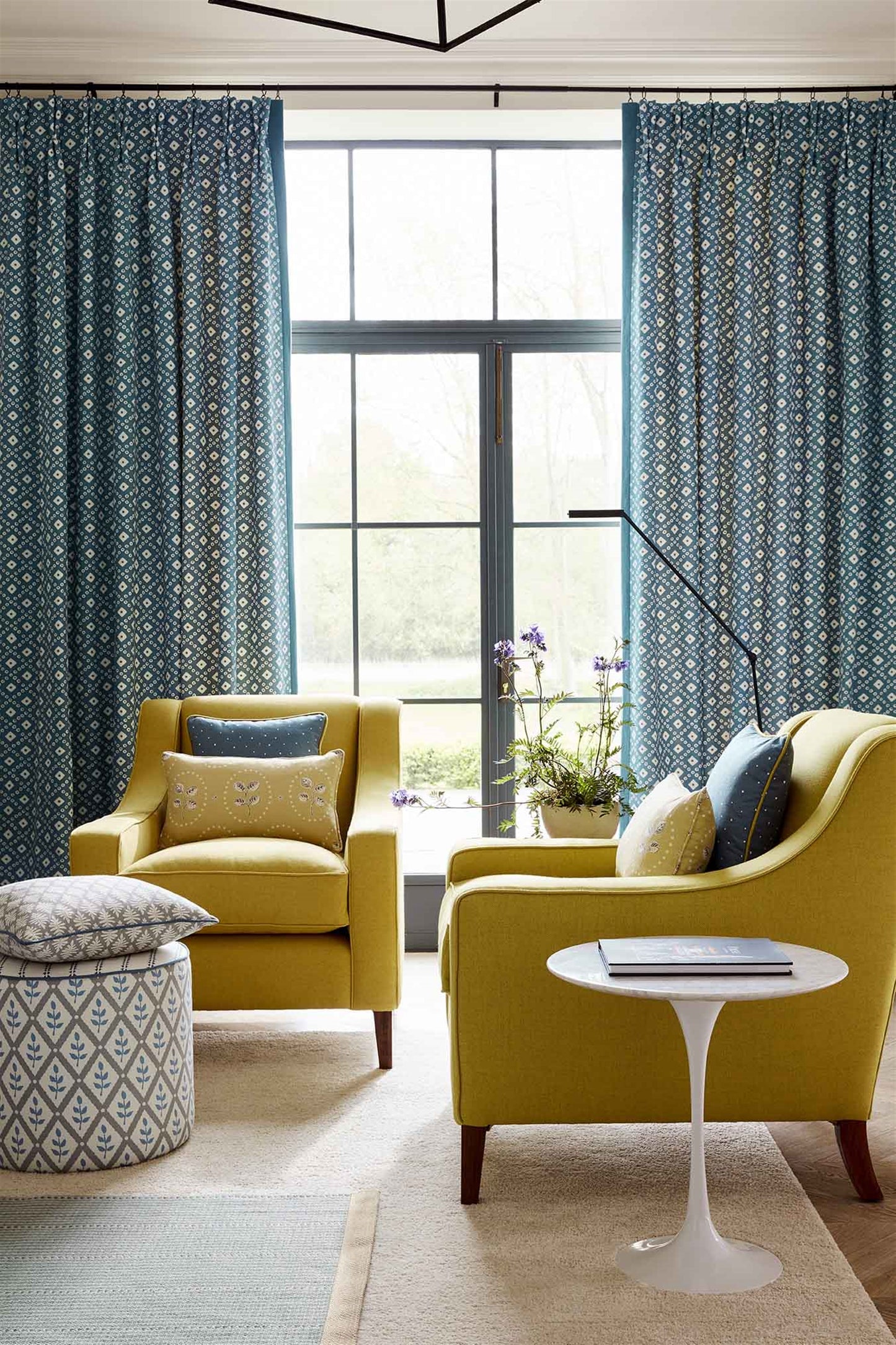
Plain Linen Union - Saffron
PLAIN-LU-52-FABRIC
Composition:63% Cotton 37% Linen
Width:138 cm
Pattern Repeat: 0cm
Fabric by the metre
Quantity:
Create curtains, blinds & more
Use the fabric to create...
Create furniture
Use this fabric on bespoke furniture...
In stock
Couldn't load pickup availability

Change fabric
How to measure up for your curtains
Before you start, we recommend that your curtain pole or track is already fitted. Ideally, it should extend about 30cm beyond each side of the window (as shown in the pole diagram lower down this guide) so that, when the curtains are open, they let in as much light as possible. It should also sit around 15 cm above the window frame. Please use metric units only when measuring.
Note: When ordering curtains through our website, fabric widths and pattern repeats are calculated automatically for you — so you can focus simply on getting your measurements right.
Reassurance: Take your time, double-check your measurements, and refer back to the diagrams as you go. If something doesn’t look quite right, measure again — there’s no rush. If you are unsure of anything, please do give us a call. We would be delighted to help you.
A quick note on “eyelets”
Pole Eyelets: When using a pole, an eyelet is the small metal ring that is screwed into the bottom of the curtain rings. Please measure from the centre of the hole in the eyelet.
Track eyelets: When using a curtain track, an eyelet is the plastic circular ring that hangs below the track (below picture shows the back of the curtain track). Please measure from the centre of the hole in the eyelet.
Poles
Width (A):
Measure the distance between the finials (the decorative ends of the pole). This is labelled A in the diagram below.
-------------------
Drop (B to C) for pencil pleat, double pleat, and triple pleat curtains:
- The starting point is where you would like the top of the curtain to be. Normally this is 2-5cm above the eyelet, depending on how much of the pole and rings you would like to hide. This point is labelled B in the diagram.
- From point B, measure straight down to where you want the curtain to finish, typically to the floor. This point is labelled C in the diagram.
This full measurement (B to C) is your curtain drop.
Curtain drop for cottage pleat (5 cm or 10 cm depth):
- Measure from the eyelet straight down to the floor.
- Then add either 5 cm or 10 cm, depending on your chosen cottage pleat style.
Curtain drop for flop over frill:
- Measure from the eyelet to the floor.
- Don’t add anything extra for the frill — we will include that for you.
Good to know: We automatically add approximately 25 cm for the hem at the bottom of all curtains.
Tracks
Width
Measure the length of the track.
---------------------
Drop (D) for pencil pleat, double pleat, and triple pleat curtains:
- Start 1 cm above the track (as shown at the top of the diagram).
- Measure straight down to where you want the curtain to finish, typically to the floor. (labelled D).
This is your curtain drop.
Drop for cottage pleat (5cm or 10cm depth):
- Measure from the eyelet down to the floor.
- Add 5cm or 10cm, depending on your chosen depth.
Drop for flop over frill:
- Measure from the eyelet to the floor.
- Don’t add extra for the frill — we will take care of this.
Good to know: We automatically add approximately 25 cm for the hem at the bottom of all curtains.
What is a pole & track?
Curtain Pole: A decorative rod where curtains hang on rings. Best for a stylish, visible finish.
Curtain Track: A discreet rail system with gliders that lets curtains slide smoothly. Ideal for a minimal look or tight spaces.
Not so good to look at as a pole, you might want to make a curtain pelmet to hide the curtain track.
Types of curtain headings
All of our curtains are hand-finished using high-quality lining and interlining for a luxurious look and feel. Each pair is supplied with hooks and arrives ready to hang.
Curtain weights are discreetly sewn into the hems to help the curtains hang beautifully, creating a smooth, even drape. They also reduce movement from draughts and help the curtains maintain their shape over time, resulting in a more elegant and professional finish.
-----------------------------
Pencil Pleat
Available with either a 3" or 6" heading depth.
Pencil pleat is a classic and versatile curtain heading, created using a tape sewn to the back of the curtain. When gathered, it forms a series of neat, evenly spaced folds resembling a row of pencils. A key advantage of this heading style is its adjustable width. By tightening or loosening the cords within the tape, the curtains can be adapted to fit different sized tracks or poles, making them a practical and flexible choice.
Double or Triple Pleat
Double and triple pleat headings offer a smart, tailored appearance. Suitable for any room in the home, each pleat is carefully hand-formed and sewn to create beautifully uniform folds and an elegant drape. As these curtains are made specifically to your exact measurements, the heading is fixed and cannot be adjusted.
Cottage Pleat
Available with two frill depth options: 5cm and 10cm.
Cottage pleat curtains are made using a 1" tape sewn to the back of the fabric, creating a soft, gently gathered frill above the heading. This produces a relaxed yet structured look.
Flop Over Frill
A soft, luxurious-looking heading. Frill length is approximately 15cm (depends on pattern).
Help with Linings
Standard Lining
We use a high quality ivory coloured 100% cotton lining fabric.
Our curtains can be lined with an ivory blackout lining to block out the light and help insulate against heat loss or gain.
Choosing to line your curtains in a second fabric
You can give your curtains a bespoke look by adding another one of our fabrics to the reverse, as seen in the images below. All of our fabrics can be used for lining, although the lining fabric may fade if exposed to direct sunlight for an extended period of time. This might be a better choice for north facing rooms.
This is a popular thing to do for curtains for ground floor french doors, where you will frequently see the back of the curtains.
Interlining
We use a good quality medium weight interlining. Interlining gives a heavier and more luxurious look and insulates against heat loss. It is recommended for all curtains and can be used for Roman Blinds as well.
What is a leading edge?
Whether it's a plain fabric,or a printed fabric, you might consider giving your curtain a complementary or contrasting brder to create a statement. It is an 8cm border that runs the length of the interior of the curtain or curtains, where there is more handling. If you would like a bespoke width that's more suited to your needs, please get in touch so we can discuss this further.
This border gives you the oppotunity to bring in another colour into your room. You may want to tie your curtains in with your wall colour or your upholstery.
What are tie backs?
We can offer tie backs for either a single, or pairs of curtains. They will be made in the same fabric as your curtains with the option of contrast piping.
Change fabric
How to measure up for your roller blinds
Inside a Window Recess
Width: Measure the width of the recess from the left to the right (see E on the diagram)
Length: Measure from the top of the recess to the bottom (see E on the diagram)
------------------
YOU ONLY NEED TO PROVIDE US WITH THE FULL RECESS MEASUREMENT
The maker will allow room for the rolling mechanism when making the blinds. The metal brackets from which the blind hangs will take up 1.5cm on each side of the recess. This may allow some light through, even with a blackout lining.
Outside a Window Recess
Width: Measure the outside of the window recess (see F on diagram) and add at least 5cms on each side to minimise any light escaping through.
Length: Measure from where you would like the blind to hang from above the window to the length you require (see F on the diagram). We recommend adding at least 5cm to the recess length measurement.
-----------------------
This guidance also applies to blinds fitted outside a door recess. In such cases, simply provide the desired finished width and length of the blind.
----------------------
Note: For roller blinds fitted outside the recess, an allowance must be made for the operating mechanism at either end of the roller, typically measuring approximately 1.5cm per side. If, for example, you would like the fabric width of your blind to be 100cm, it is important to specify this clearly as the “finished fabric width” when placing your order. If this is not specified, our makers will assume that the measurement provided refers to the overall width of the blind, including the mechanism. In such cases, the fabric itself will be reduced accordingly — resulting in a fabric width of approximately 97cm, with the remaining 3cm allocated to the mechanism. In practical terms, a blind with a 100cm finished fabric width will have an overall width of approximately 103cm once the mechanism is included.
Your roller blinds will be delivered complete with hanging instructions and fittings.
Which treatment should you choose
Laminated Blind
The laminated lining is white in colour and is adhered to the reverse side of the main fabric.
Processed Blind
Processed blinds are made using the fabric alone, without any lining. A clear stiffening treatment is applied to provide structure and rigidity. The maximum width for a processed blind is 133cm.
Help to choose
Reverse Rolled
With reverse rolled blinds, the fabric falls from the front of the roll, concealing the white roll at the top and preventing the reverse lining from being visible (not applicable to processed blinds). Reverse rolling is also a better option for windows with protruding handles, door handles, or taps, as it allows the blind to clear these obstacles more effectively. In addition, it creates a cleaner, more streamlined appearance.
Standard Rolled
Standard rolled blinds position the fabric closer to the window, helping to reduce draughts, improve light blockage, and prevent items on the windowsill from being disturbed. If you prefer not to see the white roll at the top, which exposes the reverse lining, it can be concealed with a matching pelmet for a cleaner, more finished look (see image on the right).
Choosing your bottom border
We provide bottom borders for all Roller Blinds. All of our fabrics are suitable for bottom borders, for example you could choose a colour to complement your blind fabric, or, a contrasting fabric altogether that brings in a colour seen elsewhere in the room; the choice is yours!
Adding a roller pelmet
These pelmets have been made to hide the white roll that reveals the reverse lining at the top. It creates a seamless finish because the design is pattern matched to the blinds fabric.
This only applies to roller blinds that are installed inside of a recess.
If you would like just one pelmet to cover multiple Roller Blinds in the same window, then please call us to discuss this further. If you would like the same fabric for the blind and pelmet, then depending on the pattern, it may not be perfectly aligned. However, we do our best to get it as closely aligned as possible. As an alternative, think about using a fabric for the pelmet from our Plain Linen Union collection that, if you would like, could match the bottom border of your blind and give it a unified look.
Measuring a window with splayed sides
If your recess has any angle to it, you must measure the width of the area where the pelmet will sit (the location of the pelmet within the recess is up to you), and include the measurement as your "finished pelmet width" in your purchase. So for instance the pelmet might be made 20cm longer than the blind. You can trim the pelmet in situ to get a pefect fit.
Change fabric
How to measure up for your Roman blind
INSIDE A WINDOW RECESS
Width: Measure across the recess at several points and give the narrowest measurement minus 1cm for clearance so the blind will run freely (see E on the diagram)
Length: Measure from the top of the recess to the bottom (see E on the diagram)
OUTSIDE A WINDOW RECESS
Width: Measure the width of the recess and add at least 5cms on each side for overlapping (see F on the diagram)
Length: Measure from the required starting position above the window to the length you require, adding 5cms on the length
Types of mechanism
This is a traditional folding blind. The Made to Measure Roman Blind is supplied with two options:
A wooden batten with a corded pull
A Wooden Batten with a corded pull. Also provided will be an acorn and 2 cleats. Both options are available, however, due to increased health and safety restrictions, blinds over 1.3 metres in width and 1.5 metres in drop must be ordered on arotary chain track. This is because the pressure required to pull up the larger blind tends to cause the safety 'break aways' to pop open as would a child pulling on the cords.
A rotary chain track with a bead
A Rotary Chain Track with a choice of bead colours.Please note that the minimum width for a Roman Blind on rotary chain track is 50cm.
Which control weight to choose
The control weights below are only available for the Wooden Baton options.
The Chain Beads are only available for the Rotary Track options.
Chain Beads: Gun Metal, Pewter, Chrome, Antique Bronze. Please note that the darker bead options may mark the reverse of lighter coloured fabrics.
Choosing your contrast border
Your blind can be lined with a standard cream cotton lining, a blackout lining, or a second Vanessa Arbuthnott fabric of your choice.
Choose either a bottom border or an all-around border for your Roman blind; the border will cover the left, bottom, and right sides of the blind, not the top. The border is approximately 5cm wide, but the exact width will depend on how big the blind is.
Ths gives ou a chance to bring a second colour into your room, maybe coordinating with curtains or wall colour etc.
As an alternative, you can opt for the borderless option which comes as standard.
Adding a pelmet
For your Roman blinds, we can create custom pelmets to ensure a flawless finish. With their returns on either side, these conceal the track or batten from which the blinds hang, giving your room a neat appearance.Only applies to Roman blinds installed outside of a recess.
Change fabric
Cushion shapes and sizes
We offer three variations of a square, two sizes of a rectangular, and two sizes for a bolster:
SQUARE:
- 40cm x 40cm / 16" x 16"
- 46cm x 46cm / 18" x 18"
- 51cm x 51cm / 20" x 20"
RECTANGULAR:
- 30cm x 51cm / 12" x 20"
- 40cm x 60cm / 16" x 24"
BOLSTER:
- 51cm x 20cm / 20" x 8"
- 100cm x 25cm / 39.5" x 10"
Cushion style
We provide the following finishes on our cushions:
- Piped and Zipped, square or rectangular. This can either be self-piped, or piped in a contrast fabric of your choice
- Buttoned and Enveloped, square or rectangular.
- With ties, square shape only.
- Frilled all round, square shape only.
- Double Sided, square or rectangular
- Pleated ends, rectangular shape only.
- 4cm Flange, square shape only.
- Bolster. Can be self-piped, contrast piped, or have different fabric on the flat ends.
It is a good idea to choose a variety of cushion shapes and finishes to add interest to you room
Change fabric
Quilt size help
There are four sizes of quilts on offer. Choose your size and style before adding the reverse fabric. Choosing a larger sized Quilt to that of you bed ensures that the Quilt drapes over, so please measure in advance.
- SMALL: 140cm x 215cm
- MEDIUM: 185cm x 215cm
- LARGE: 200cm x 225cm
- EXTRA LARGE: 235cm x 225cm
Help with Quilt edging
We can offer up to three different fabric choices for your quilt, which have the following edgings available:
Piped Edge
8cm frill
Flat Border
Change fabric
Choose your lampshade style
Drum
Drum lampshades can be created with or without a contrast lining fabric of your choice, and made to fit either ceiling pendants or lamp bases.
Empire
Classic slope style with a flat surface, available for pendants or lamp bases. A contrasting fabric lining is not available with this option.
Candle - smaller empire, always sold as a pair
These are the smaller empire-style lampshades, which are always sold in pairs. The shade is attached to the light bulb using a 'candle clip fitting'. Contrast linings are unavailable.
Pleated
A slightly slanted imperial lampshade with a pleated finish and a cream cotton lining.
Help with lampshade sizing
DRUM
Size: Diameter 20cm x Height 20cm, 25cm or 30cm
Size: Diameter 30cm x Height 20cm, 25cm, 30cm or 35cm
Size: Diameter 40cm x Height 20cm, 25cm, 30cm, 35cm or 40cm
Size: Diameter 50cm x Height 30cm
EMPIRE
Small: Top Diameter 10cm x Height 17cm x Base 25cm
Medium: Top Diameter 15cm x Height 25.5cm x Base 40cm
Large: Top Diameter 20cm x Height 26cm x Base 40cm
PAIR OF CANDLE SHADES
Size: Top Diameter 8cm x Height 13cm x Base 14.5cm
PLEATED
Small: 10" - Top Diameter 15cm x Height 17.5 cm x Base 25cm
Medium: 12" - Top Diameter 18cm x Height 20cm x Base 30cm
Large: 14" - Top Diameter 20cm x Height 22.5cm x Base 35cm
Extra Large: 16" - Top Diameter 25cm x Height 25cm x Base 40cm
Help with Fitting Types
Select whether you would like your shade/s to be used as a ceiling pendant, or to be placed on a lamp base (lamp base is not included upon purchase of the lampshade). If you would like to include a lampshade diffuser (only suitable for drum ceiling lampshades), then please phone, or email us for a quote. Diffusers will block the harsh glare and soften the light given out by the bulb.
Change fabric
Piping Information
If you would like your piping in the same fabric that you have chosen for your chair, choose 'same fabric'. For contrast piping select 'different fabric' - there will be an additional cost to have a second fabric.
Piped in a different fabric
Piped in the same fabric
Help with Cushion Fillings
Feather Wrapped Foam cushions consist of a high density foam block surrounded by feathers. They require a minimal amount of plumping-up and maintenance. They hold their shape very well and offer a good level of support and comfort. They are perfect for larger 2/3 seater sofas and chair seats.
Feather cushions are ideal as back cushions and seat cushions too. If you are after a softer, lighter, more luxurious cushion and you don’t mind plumping them up from time to time, go for feathers.
Foam cushions offer a much more sturdier base, go for these if you would like a firmer seat that you don't sink in to.
Help with Sofa Leg Options
Please note not all leg types apply to all pieces of furniture. You will only be offered the leg types available to for your chosen sofa model
For TRADITIONAL sofas you can choose either tapered or turned legs.
If you choose turned legs you can have:
- No castors
- Castors to the front legs only
- Castors to all four legs
For CHEDWORTH and CIRENCESTER sofa you can ony have square tapered legs
Tapered legs with or without castors look more traditional whilst square tapered legs give a more modern feel to a room
Help with 'Scotchgard'
Scotchgard is a chemical finish that prevents water, oils, or stains from entering the fabric and forming a bond.
This is a stain and water repellent designed for fabrics and upholstery. It works by applying an invisible barrier that causes liquids to bead up on the surface. This prevents spills from soaking into the fibres, allowing you to easily blot them away before they set.
Change fabric
Piping Information
If you would like your piping in the same fabric that you have chosen for your chair, choose 'same fabric'. For contrast piping select 'different fabric' - there will be an additional cost to have a second fabric.
Piped in a different fabric
Piped in the same fabric
Help with Cushion Fillings
Feather Wrapped Foam cushions consist of a high density foam block surrounded by feathers. They require a minimal amount of plumping-up and maintenance. They hold their shape very well and offer a good level of support and comfort. They are perfect for larger 2/3 seater sofas and chair seats.
Feather cushions are ideal as back cushions and seat cushions too. If you are after a softer, lighter, more luxurious cushion and you don’t mind plumping them up from time to time, go for feathers.
Foam cushions offer a much more sturdier base, go for these if you would like a firmer seat that you don't sink in to.
Help With Leg Options
Please note not all leg types apply to all pieces of furniture. You will only be offered the leg types available to you for your chosen chair model
For Traditional chairs you can choose either square tapered or turned legs.
If you choose turned legs you can have:
- No castors
- Castors to the front legs only
- Castors to all four legs
SAPPERTON CHAIRS
For Sapperton chairs you can only choose:
- Turned legs with no castors
- Turned legs with castors on the front two legs only
TUB CHAIRS
Tub chairs come with long tapered legs only
CHEDWORTH CHAIRS
You can only choose square tapered legs
Help with 'Scotchgard'
Scotchgard is a chemical finish that prevents water, oils, or stains from entering the fabric and forming a bond.
This is a stain and water repellent designed for fabrics and upholstery. It works by applying an invisible barrier that causes liquids to bead up on the surface. This prevents spills from soaking into the fibres, allowing you to easily blot them away before they set.
Change fabric
Footstool and Pouffe Piping Information
If you would like the piping in the same fabric that you have chosen for your main fabric, choose 'same fabric'. For contrast piping select 'different fabric' - there will be an small additional cost to have a second fabric.
Piped in the same fabric
Piped in a different fabric
Help with Footstool Leg Options
Please note not all leg types apply to all pieces of furniture. You will only be offered the leg types available to for your chosen chair, sofa or footstool model
For a Traditional Chair you can choose whether or not to have turned legs with casters on all four legs, see photos here:
Turned legs with no castors:
Tub chairs have long tapered legs only
Tapered legs on footstools, sofas and chairs, give a more modern feel to a room
Help with 'Scotchgard'
Scotchgard is a chemical finish that prevents water, oils, or stains from entering the fabric and forming a bond.
This is a stain and water repellent designed for fabrics and upholstery. It works by applying an invisible barrier that causes liquids to bead up on the surface. This prevents spills from soaking into the fibres, allowing you to easily blot them away before they set.
Change fabric
Headboard Border and Piping Information
If you would like your piping in the same fabric that you have chosen for your main fabric, choose 'same fabric'. For contrast piping select 'different fabric' - there will be a small additional cost to have a second fabric.
BORDERS & PIPING
Rectangular and Rounded Headboards can also have a border as well as piping, in the second fabric, see below:
Border and Piping in a different fabric
Piped only, in a second fabric
Help with 'Scotchgard'
Scotchgard is a chemical finish that prevents water, oils, or stains from entering the fabric and forming a bond.
This is a stain and water repellent designed for fabrics and upholstery. It works by applying an invisible barrier that causes liquids to bead up on the surface. This prevents spills from soaking into the fibres, allowing you to easily blot them away before they set.
Suitability
Our fabrics are suitable for:
- Curtains
- Roman blinds
- Roller blinds
- Cushions
- Quilts
- Lampshades
- Chairs
- Sofas
- Headboards
- Sculptured headboards
- Footstools
- Curtain linings
- Roman blind linings
Please note: Our woven fabrics are best suited to light upholstery. For furniture that is used every day, such as family sofas, we recommend choosing one of our printed Linen Union and plain Linen Union fabrics instead. Woven fabrics are ideal for occasional chairs and other light-use pieces, where their beautiful texture can be enjoyed without the wear associated with heavy everyday use. For this reason, we do not offer our woven fabrics on our Made to Measure furniture.
Wallpaper
Our wallpapers are made in the UK and tested to European fire safety standards, making them suitable for both residential and commercial interiors.
How much fabric do I need?
HOW TO CALCULATE FABRIC QUANTITY FOR CURTAINS
1. Measure the pole or track width. Then decide on the curtain fullness (the amount of fabric that will need to be joined together to create the overall width of the curtains).
Cottage pleat / Pencil pleat / Flop-over-frill — 2.2 fullness
Double pleat — 2.3 fullness
Triple Pleat — 2.5 fullness
2. Multiply the track/pole width by your chosen fullness.
Example: for triple pleat with a pole/track measuring 150cm. Calculation is 150cm x 2.5 = 375cm
3. Next, divide that figure by the fabric width (usually 137cm) to work out how many widths of fabric are needed for this pair of curtains.
Example for triple pleat: 375cm divided by 137cm = 2.73.
Then round that up to the closest whole number to calculate how many widths you need. In the example, this is 3 widths (whole and half widths can be joined together to make wider curtains)
4. Measure the required length of your planned curtain from top to bottom. Add 30cm for the hem to calculate the total curtain drop. Then multiply the curtain drop figure by the number of widths required and round up to the nearest metre to determine how much fabric to order.
Example for triple pleat: Length of curtain is 180cm. 180cm curtain length + 30cm for hem = 210cm drop. 210cm drop x 3 widths required = 630cm. So you need to order 7 metres.
Extra steps for patterned fabric:
5. If you're choosing patterned fabric, you need to consider whether extra fabric is required to match the pattern across the widths of fabric in your curtain. To calculate this, you take the curtain drop measurement and divide it by the pattern repeat measurement.
Example: Curtain drop of 210cm and pattern repeat measurement 64cm.
210cm drop ÷ 64cm pattern repeat = 3.75 pattern repeats, which is rounded up to 4.
6. Then multiply the number of pattern repeats by the pattern repeat measurement to calculate the extra fabric required for one width of fabric.
Example: So each width of fabric will need 4 x 64cm pattern repeats = 256cm.
7. Finally multiply that figure by the number of required widths (calculated in step 3) and round to the nearest whole metre to calculate the amount of fabric you need to order.
Example: In this example 3 widths so 3 x 256cm = 768cm, which rounds up to 8 metres. So you need 8 metres of fabric (rather than the 7 metres calculated in Step 4 to ensure the pattern repeats on the fabric can be matched).
Steps 5-7 are important for patterned fabric because it is better to have a small amount of fabric spare (can be useful for making cushions and tie backs) rather than struggling to rescue curtains made from too little fabric.
HOW TO CALCULATE FABRIC FOR A ROMAN BLIND
1. Calculate the ‘drop’ measurement by taking the required length of the finished blind (measured from top to bottom) and adding 25cm for the blind’s heading and hem.
Example: If the blind requires a finished length of 140cm, its drop measurement will be 140cm + 25cm = 165cm.
2. If the finished width of the blind is less than 132cm, then the drop calculation rounded to the nearest whole metre is the amount of fabric you need to order.
Example: a blind that is 130cm wide with a drop of 165cm would require a fabric order of 2 metres of fabric.
3. If the finished width of the blind is more than 132cm, another width of fabric will be required. This is because our fabric is 137cm wide and each blind needs an extra 2.5cm on each side to make the hems. So you need to multiply the drop measurement by 2 to calculate the required quantity of fabric and then round up to the nearest metre.
Example: a blind that is 160cm wide with a drop of 165cm would lead to this calculation: 165cm x 2 = 330cm, which means 4 metres needs to be ordered.
Extra step for patterned fabric:
4. You need to add the length of one pattern repeat to ensure pattern matching and then round up to the nearest metre.
Example: if the drop is 195cm (width of less than 132cm) with a pattern repeat that is 64cm long, the calculation is 195cm + 64cm = 259cm. So you would need to order 3 metres of fabric rather than the 2 metres you would order if the fabric was not patterned.
HOW TO CALCULATE FABRIC FOR A ROLLER BLIND
1. Calculate the ‘drop’ measurement by taking the required length of the finished blind (measured from top to bottom) and adding 45cm for the blind’s heading and hem.
Example: If the finished length of the blind is 140cm then the calculation is 140cm + 45cm for the heading and hem = 185cm drop.
2. If the finished width of the blind is less than 132cm, then the drop calculation rounded to the nearest whole metre is the amount of fabric you need to order.
Example: a blind that is 120cm wide with a drop of 185cm would require a fabric order of 2 metres of fabric.
3. If the finished width of the blind is more than 132cm, another drop of fabric will be required. This is because our fabric is 137cm wide and each blind needs an extra 2.5cm on each side to make the hems. So you need to multiply the drop measurement by 2 to calculate the required quantity of fabric and then round to the nearest metre.
Example: a blind that is 140cm wide with a drop of 185cm would lead to a calculation of 185cm x 2 = 370cm and therefore require a fabric order of 4 metres of fabric.
Extra step for patterned fabric:
4. You need to add the length of one pattern repeat to ensure pattern matching.
Example: If the drop is 185cm, the width is greater than 132cm and the pattern repeat is 64cm, the calculation is 370cm + 64cm = 434cm. So you need to order 5 metres of fabric rather than 4 if the fabric was not patterned.
What is the difference?
A free sample is approximately A5 in size, but larger if the pattern is on a bigger scale.
A returnable sample is 0.5m and is the full width of the fabric (139cm); this you buy and then on it is safe return in a good condition within 28 days it is refunded.
The half metre enables you to really see the design and see how it might look in your room. we would suggest you lay it on the back of your sofa or chair or pin it to your existing curtains.
What is a pole & track?
Curtain Pole: A decorative rod where curtains hang on rings. Best for a stylish, visible finish.
Curtain Track: A discreet rail system with gliders that lets curtains slide smoothly. Ideal for a minimal look or tight spaces.
Not so good to look at as a pole, you might want to make a curtain pelmet to hide the curtain track.
What is a pole & track?
Curtain Pole: A decorative rod where curtains hang on rings. Best for a stylish, visible finish.
Curtain Track: A discreet rail system with gliders that lets curtains slide smoothly. Ideal for a minimal look or tight spaces.
Not so good to look at as a pole, you might want to make a curtain pelmet to hide the curtain track.
Types of curtain headings
All of our curtains are hand-finished using high-quality lining and interlining for a luxurious look and feel. Each pair is supplied with hooks and arrives ready to hang.
Curtain weights are discreetly sewn into the hems to help the curtains hang beautifully, creating a smooth, even drape. They also reduce movement from draughts and help the curtains maintain their shape over time, resulting in a more elegant and professional finish.
-----------------------------
Pencil Pleat
Available with either a 3" or 6" heading depth.
Pencil pleat is a classic and versatile curtain heading, created using a tape sewn to the back of the curtain. When gathered, it forms a series of neat, evenly spaced folds resembling a row of pencils. A key advantage of this heading style is its adjustable width. By tightening or loosening the cords within the tape, the curtains can be adapted to fit different sized tracks or poles, making them a practical and flexible choice.
Double or Triple Pleat
Double and triple pleat headings offer a smart, tailored appearance. Suitable for any room in the home, each pleat is carefully hand-formed and sewn to create beautifully uniform folds and an elegant drape. As these curtains are made specifically to your exact measurements, the heading is fixed and cannot be adjusted.
Cottage Pleat
Available with two frill depth options: 5cm and 10cm.
Cottage pleat curtains are made using a 1" tape sewn to the back of the fabric, creating a soft, gently gathered frill above the heading. This produces a relaxed yet structured look.
Flop Over Frill
A soft, luxurious-looking heading. Frill length is approximately 15cm (depends on pattern).
Help with Linings
Standard Lining
We use a high quality ivory coloured 100% cotton lining fabric.
Our curtains can be lined with an ivory blackout lining to block out the light and help insulate against heat loss or gain.
Choosing to line your curtains in a second fabric
You can give your curtains a bespoke look by adding another one of our fabrics to the reverse, as seen in the images below. All of our fabrics can be used for lining, although the lining fabric may fade if exposed to direct sunlight for an extended period of time. This might be a better choice for north facing rooms.
This is a popular thing to do for curtains for ground floor french doors, where you will frequently see the back of the curtains.
Interlining
We use a good quality medium weight interlining. Interlining gives a heavier and more luxurious look and insulates against heat loss. It is recommended for all curtains and can be used for Roman Blinds as well.
What is a leading edge?
Whether it's a plain fabric,or a printed fabric, you might consider giving your curtain a complementary or contrasting brder to create a statement. It is an 8cm border that runs the length of the interior of the curtain or curtains, where there is more handling. If you would like a bespoke width that's more suited to your needs, please get in touch so we can discuss this further.
This border gives you the oppotunity to bring in another colour into your room. You may want to tie your curtains in with your wall colour or your upholstery.
What are tie backs?
We can offer tie backs for either a single, or pairs of curtains. They will be made in the same fabric as your curtains with the option of contrast piping.
Which control weight to choose
The control weights below are only available for the Wooden Baton options.
The Chain Beads are only available for the Rotary Track options.
Chain Beads: Gun Metal, Pewter, Chrome, Antique Bronze. Please note that the darker bead options may mark the reverse of lighter coloured fabrics.
How to measure up for your Roman blind
INSIDE A WINDOW RECESS
Width: Measure across the recess at several points and give the narrowest measurement minus 1cm for clearance so the blind will run freely (see E on the diagram)
Length: Measure from the top of the recess to the bottom (see E on the diagram)
OUTSIDE A WINDOW RECESS
Width: Measure the width of the recess and add at least 5cms on each side for overlapping (see F on the diagram)
Length: Measure from the required starting position above the window to the length you require, adding 5cms on the length
Types of mechanism
This is a traditional folding blind. The Made to Measure Roman Blind is supplied with two options:
A wooden batten with a corded pull
A Wooden Batten with a corded pull. Also provided will be an acorn and 2 cleats. Both options are available, however, due to increased health and safety restrictions, blinds over 1.3 metres in width and 1.5 metres in drop must be ordered on arotary chain track. This is because the pressure required to pull up the larger blind tends to cause the safety 'break aways' to pop open as would a child pulling on the cords.
A rotary chain track with a bead
A Rotary Chain Track with a choice of bead colours.Please note that the minimum width for a Roman Blind on rotary chain track is 50cm.
Choosing your contrast border
Your blind can be lined with a standard cream cotton lining, a blackout lining, or a second Vanessa Arbuthnott fabric of your choice.
Choose either a bottom border or an all-around border for your Roman blind; the border will cover the left, bottom, and right sides of the blind, not the top. The border is approximately 5cm wide, but the exact width will depend on how big the blind is.
Ths gives ou a chance to bring a second colour into your room, maybe coordinating with curtains or wall colour etc.
As an alternative, you can opt for the borderless option which comes as standard.
Adding a pelmet
For your Roman blinds, we can create custom pelmets to ensure a flawless finish. With their returns on either side, these conceal the track or batten from which the blinds hang, giving your room a neat appearance.Only applies to Roman blinds installed outside of a recess.
How to measure up for your roller blinds
Inside a Window Recess
Width: Measure the width of the recess from the left to the right (see E on the diagram)
Length: Measure from the top of the recess to the bottom (see E on the diagram)
------------------
YOU ONLY NEED TO PROVIDE US WITH THE FULL RECESS MEASUREMENT
The maker will allow room for the rolling mechanism when making the blinds. The metal brackets from which the blind hangs will take up 1.5cm on each side of the recess. This may allow some light through, even with a blackout lining.
Outside a Window Recess
Width: Measure the outside of the window recess (see F on diagram) and add at least 5cms on each side to minimise any light escaping through.
Length: Measure from where you would like the blind to hang from above the window to the length you require (see F on the diagram). We recommend adding at least 5cm to the recess length measurement.
-----------------------
This guidance also applies to blinds fitted outside a door recess. In such cases, simply provide the desired finished width and length of the blind.
----------------------
Note: For roller blinds fitted outside the recess, an allowance must be made for the operating mechanism at either end of the roller, typically measuring approximately 1.5cm per side. If, for example, you would like the fabric width of your blind to be 100cm, it is important to specify this clearly as the “finished fabric width” when placing your order. If this is not specified, our makers will assume that the measurement provided refers to the overall width of the blind, including the mechanism. In such cases, the fabric itself will be reduced accordingly — resulting in a fabric width of approximately 97cm, with the remaining 3cm allocated to the mechanism. In practical terms, a blind with a 100cm finished fabric width will have an overall width of approximately 103cm once the mechanism is included.
Your roller blinds will be delivered complete with hanging instructions and fittings.
Which treatment should you choose
Laminated Blind
The laminated lining is white in colour and is adhered to the reverse side of the main fabric.
Processed Blind
Processed blinds are made using the fabric alone, without any lining. A clear stiffening treatment is applied to provide structure and rigidity. The maximum width for a processed blind is 133cm.
Choosing your bottom border
We provide bottom borders for all Roller Blinds. All of our fabrics are suitable for bottom borders, for example you could choose a colour to complement your blind fabric, or, a contrasting fabric altogether that brings in a colour seen elsewhere in the room; the choice is yours!
Help to choose
Reverse Rolled
With reverse rolled blinds, the fabric falls from the front of the roll, concealing the white roll at the top and preventing the reverse lining from being visible (not applicable to processed blinds). Reverse rolling is also a better option for windows with protruding handles, door handles, or taps, as it allows the blind to clear these obstacles more effectively. In addition, it creates a cleaner, more streamlined appearance.
Standard Rolled
Standard rolled blinds position the fabric closer to the window, helping to reduce draughts, improve light blockage, and prevent items on the windowsill from being disturbed. If you prefer not to see the white roll at the top, which exposes the reverse lining, it can be concealed with a matching pelmet for a cleaner, more finished look (see image on the right).
Cushion shapes and sizes
We offer three variations of a square, two sizes of a rectangular, and two sizes for a bolster:
SQUARE:
- 40cm x 40cm / 16" x 16"
- 46cm x 46cm / 18" x 18"
- 51cm x 51cm / 20" x 20"
RECTANGULAR:
- 30cm x 51cm / 12" x 20"
- 40cm x 60cm / 16" x 24"
BOLSTER:
- 51cm x 20cm / 20" x 8"
- 100cm x 25cm / 39.5" x 10"
Cushion style
We provide the following finishes on our cushions:
- Piped and Zipped, square or rectangular. This can either be self-piped, or piped in a contrast fabric of your choice
- Buttoned and Enveloped, square or rectangular.
- With ties, square shape only.
- Frilled all round, square shape only.
- Double Sided, square or rectangular
- Pleated ends, rectangular shape only.
- 4cm Flange, square shape only.
- Bolster. Can be self-piped, contrast piped, or have different fabric on the flat ends.
It is a good idea to choose a variety of cushion shapes and finishes to add interest to you room
Quilt size help
There are four sizes of quilts on offer. Choose your size and style before adding the reverse fabric. Choosing a larger sized Quilt to that of you bed ensures that the Quilt drapes over, so please measure in advance.
- SMALL: 140cm x 215cm
- MEDIUM: 185cm x 215cm
- LARGE: 200cm x 225cm
- EXTRA LARGE: 235cm x 225cm
Help with Quilt edging
We can offer up to three different fabric choices for your quilt, which have the following edgings available:
Piped Edge
8cm frill
Flat Border
Piping Information
If you would like your piping in the same fabric that you have chosen for your chair, choose 'same fabric'. For contrast piping select 'different fabric' - there will be an additional cost to have a second fabric.
Piped in a different fabric
Piped in the same fabric
Help with Cushion Fillings
Feather Wrapped Foam cushions consist of a high density foam block surrounded by feathers. They require a minimal amount of plumping-up and maintenance. They hold their shape very well and offer a good level of support and comfort. They are perfect for larger 2/3 seater sofas and chair seats.
Feather cushions are ideal as back cushions and seat cushions too. If you are after a softer, lighter, more luxurious cushion and you don’t mind plumping them up from time to time, go for feathers.
Foam cushions offer a much more sturdier base, go for these if you would like a firmer seat that you don't sink in to.
Help with Sofa Leg Options
Please note not all leg types apply to all pieces of furniture. You will only be offered the leg types available to for your chosen sofa model
For TRADITIONAL sofas you can choose either tapered or turned legs.
If you choose turned legs you can have:
- No castors
- Castors to the front legs only
- Castors to all four legs
For CHEDWORTH and CIRENCESTER sofa you can ony have square tapered legs
Tapered legs with or without castors look more traditional whilst square tapered legs give a more modern feel to a room
Help with 'Scotchgard'
Scotchgard is a chemical finish that prevents water, oils, or stains from entering the fabric and forming a bond.
This is a stain and water repellent designed for fabrics and upholstery. It works by applying an invisible barrier that causes liquids to bead up on the surface. This prevents spills from soaking into the fibres, allowing you to easily blot them away before they set.
Piping Information
If you would like your piping in the same fabric that you have chosen for your chair, choose 'same fabric'. For contrast piping select 'different fabric' - there will be an additional cost to have a second fabric.
Piped in a different fabric
Piped in the same fabric
Help with Cushion Fillings
Feather Wrapped Foam cushions consist of a high density foam block surrounded by feathers. They require a minimal amount of plumping-up and maintenance. They hold their shape very well and offer a good level of support and comfort. They are perfect for larger 2/3 seater sofas and chair seats.
Feather cushions are ideal as back cushions and seat cushions too. If you are after a softer, lighter, more luxurious cushion and you don’t mind plumping them up from time to time, go for feathers.
Foam cushions offer a much more sturdier base, go for these if you would like a firmer seat that you don't sink in to.
Help With Leg Options
Please note not all leg types apply to all pieces of furniture. You will only be offered the leg types available to you for your chosen chair model
For Traditional chairs you can choose either square tapered or turned legs.
If you choose turned legs you can have:
- No castors
- Castors to the front legs only
- Castors to all four legs
SAPPERTON CHAIRS
For Sapperton chairs you can only choose:
- Turned legs with no castors
- Turned legs with castors on the front two legs only
TUB CHAIRS
Tub chairs come with long tapered legs only
CHEDWORTH CHAIRS
You can only choose square tapered legs
Help with 'Scotchgard'
Scotchgard is a chemical finish that prevents water, oils, or stains from entering the fabric and forming a bond.
This is a stain and water repellent designed for fabrics and upholstery. It works by applying an invisible barrier that causes liquids to bead up on the surface. This prevents spills from soaking into the fibres, allowing you to easily blot them away before they set.
Footstool and Pouffe Piping Information
If you would like the piping in the same fabric that you have chosen for your main fabric, choose 'same fabric'. For contrast piping select 'different fabric' - there will be an small additional cost to have a second fabric.
Piped in the same fabric
Piped in a different fabric
Help with Footstool Leg Options
Please note not all leg types apply to all pieces of furniture. You will only be offered the leg types available to for your chosen chair, sofa or footstool model
For a Traditional Chair you can choose whether or not to have turned legs with casters on all four legs, see photos here:
Turned legs with no castors:
Tub chairs have long tapered legs only
Tapered legs on footstools, sofas and chairs, give a more modern feel to a room
Help with 'Scotchgard'
Scotchgard is a chemical finish that prevents water, oils, or stains from entering the fabric and forming a bond.
This is a stain and water repellent designed for fabrics and upholstery. It works by applying an invisible barrier that causes liquids to bead up on the surface. This prevents spills from soaking into the fibres, allowing you to easily blot them away before they set.
Headboard Border and Piping Information
If you would like your piping in the same fabric that you have chosen for your main fabric, choose 'same fabric'. For contrast piping select 'different fabric' - there will be a small additional cost to have a second fabric.
BORDERS & PIPING
Rectangular and Rounded Headboards can also have a border as well as piping, in the second fabric, see below:
Border and Piping in a different fabric
Piped only, in a second fabric
Help with 'Scotchgard'
Scotchgard is a chemical finish that prevents water, oils, or stains from entering the fabric and forming a bond.
This is a stain and water repellent designed for fabrics and upholstery. It works by applying an invisible barrier that causes liquids to bead up on the surface. This prevents spills from soaking into the fibres, allowing you to easily blot them away before they set.
Choose your lampshade style
Drum
Drum lampshades can be created with or without a contrast lining fabric of your choice, and made to fit either ceiling pendants or lamp bases.
Empire
Classic slope style with a flat surface, available for pendants or lamp bases. A contrasting fabric lining is not available with this option.
Candle - smaller empire, always sold as a pair
These are the smaller empire-style lampshades, which are always sold in pairs. The shade is attached to the light bulb using a 'candle clip fitting'. Contrast linings are unavailable.
Pleated
A slightly slanted imperial lampshade with a pleated finish and a cream cotton lining.
Help with lampshade sizing
DRUM
Size: Diameter 20cm x Height 20cm, 25cm or 30cm
Size: Diameter 30cm x Height 20cm, 25cm, 30cm or 35cm
Size: Diameter 40cm x Height 20cm, 25cm, 30cm, 35cm or 40cm
Size: Diameter 50cm x Height 30cm
EMPIRE
Small: Top Diameter 10cm x Height 17cm x Base 25cm
Medium: Top Diameter 15cm x Height 25.5cm x Base 40cm
Large: Top Diameter 20cm x Height 26cm x Base 40cm
PAIR OF CANDLE SHADES
Size: Top Diameter 8cm x Height 13cm x Base 14.5cm
PLEATED
Small: 10" - Top Diameter 15cm x Height 17.5 cm x Base 25cm
Medium: 12" - Top Diameter 18cm x Height 20cm x Base 30cm
Large: 14" - Top Diameter 20cm x Height 22.5cm x Base 35cm
Extra Large: 16" - Top Diameter 25cm x Height 25cm x Base 40cm
Help with Fitting Types
Select whether you would like your shade/s to be used as a ceiling pendant, or to be placed on a lamp base (lamp base is not included upon purchase of the lampshade). If you would like to include a lampshade diffuser (only suitable for drum ceiling lampshades), then please phone, or email us for a quote. Diffusers will block the harsh glare and soften the light given out by the bulb.
Complementary Designs
-
Shibori - Light Pigeon, Saffron
£78.00 -
Scandi Stripe - Warm
£84.00 -
Pretty Maids - Saffron, Winter
£74.00 -
By the Sea - Saffron, Charcoal
£78.00 -
Stockholm Stripe - Dove, Saffron, Winter
£74.00 -
Stockholm Stripe - Saffron, Dove, Winter
£78.00 -
French Ticking - Saffron, Scree
£74.00 -
Cow Parsley - Saffron, Charcoal
£74.00 -
Up the Garden Path - Saffron
£74.00 -
Wild and Free - Saffron, Dormouse
£74.00
PRODUCT DETAILS
Description
Plain Linen Union – Saffron, a designer fabric from the Plain Linen Union Collection, is printed in the UK and suitable for Made to Measure upholstery and soft furnishings. We sell fabric in whole metre measurements. Martindale rub test is 36,000.
Product Details
Saffron
Composition:
63% Cotton 37% Linen
Pattern Repeat:
0.0 cm
Width:
138 cm
Washable (30°)
United Kingdom
DELIVERY
Delivery
If you order fabric or other ready-made products, delivery is usually within 3–5 working days, provided the items are in stock. We carry excellent stock levels, but if a fabric is temporarily unavailable, please allow up to 28 days for delivery. Should this be the case, we will let you know as soon as possible.
All orders are fulfilled from our office in Cirencester, where our team carefully inspects, cuts and wraps each order so quality is assured.
The breakdown is as follows:
- 1 - 2 metres - £6.00 if folded and sent by Royal Mail post.
- 1 - 2 metres - £12 on a cardboard tube. We recommend placing the fabric on this if you are making anything up, like a blind. This will help avoid creasing in transit.
- 1 metre - 20 metres - £12 on a cardboard tube.
- More than 20 metres - £25.00
REVIEWS
FAQS
Description
Plain Linen Union – Saffron, a designer fabric from the Plain Linen Union Collection, is printed in the UK and suitable for Made to Measure upholstery and soft furnishings. We sell fabric in whole metre measurements. Martindale rub test is 36,000.
Product Details
Saffron
Composition:
63% Cotton 37% Linen
Pattern Repeat:
0.0 cm
Width:
138 cm
Washable (30°)
United Kingdom
Delivery
If you order fabric or other ready-made products, delivery is usually within 3–5 working days, provided the items are in stock. We carry excellent stock levels, but if a fabric is temporarily unavailable, please allow up to 28 days for delivery. Should this be the case, we will let you know as soon as possible.
All orders are fulfilled from our office in Cirencester, where our team carefully inspects, cuts and wraps each order so quality is assured.
The breakdown is as follows:
- 1 - 2 metres - £6.00 if folded and sent by Royal Mail post.
- 1 - 2 metres - £12 on a cardboard tube. We recommend placing the fabric on this if you are making anything up, like a blind. This will help avoid creasing in transit.
- 1 metre - 20 metres - £12 on a cardboard tube.
- More than 20 metres - £25.00
Hear from our customers...
FAQs
General questions
What types of fabric do you sell?
Most of our fabrics are made from a high-quality, medium-weight Linen Union — a blend of linen and organic cotton — which is woven in Lancashire. This fabric is durable, beautifully textured, and ideal for both upholstery and curtains.
In addition to Linen Union, we also have some in 100% linen fabrics, and also our Scandinavian wovens. these are a mixure of 100% linen and Linen union. Unlike our printed fabrics the pattern is woven in these Scandinavian stripes.
Where can I order a brochure?
Yes. We have a dedicated page where you can order a hard copy of our brochures. You can also view our electronic brochure online. It’s easy to flick through at your leisure and you can even share it with a friend. Please click here to browse.
Do you have a list of your current fabric prices?
Yes, you can download or print our price list insert, which provides an overview of all products available through our Made to Measure service. It also includes a full list of our current fabric, rug, runner, and wallpaper prices.
What are the starting prices for your Made to Measure furniture & soft furnishings?
Made-to-Measure Furniture & Accessories – Starting Prices
Armchairs
- Traditional with fixed back – Starting from £2,393
- Traditional with back cushion – £2,492
- Sapperton – Starting from £2,226
- Tub – Starting from £1,735
- Chedworth – Starting from £2,284
Sofas
- Traditional with fixed back – Starting from £3,093
- Traditional with back cushions – Starting from £3,324
- Cirencester – Starting from £3,380
- Chedworth – Starting from £3,093
Footstools
- Circular Pouffe – Starting from £485
- Cube Footstool – Starting from £425
- Amberley – Starting from £1,339
- Ashcroft – Starting from £1,078
Headboards
- Rectangular – Starting from £703
- Rounded – Starting from £703
- Sculptured – Starting from £946
Cushions
- Starting from £63 (Based on 14" x 14", self-piped, zipped, in Plain Linen Union)
Quilts
- Starting from £578 (Based on a small quilt with piped edges, all in Plain Linen Union)
Lampshades
- Empire – Starting from £86
- Drum – £87
- 10" Pleated – £183
- Pair of Candle Shades (smallest size) – £54
*All prices are based on the smallest or only available size, self-piped, with feather or medium foam-filled cushions where applicable, and covered in Plain Linen Union fabric.
Why buy our fabrics?
Our Story
-
BeginningA childhood shaped by nature and craft
Raised in the Cumbrian countryside, Vanessa grew up in a creative household, with her dressmaker mother Lizzie. Educated at Blackwell House in Cumbria — the renowned Arts and Crafts school overlooking Lake Windermere — she was immersed in pattern, nature and design from an early age.
-
1980sNursing in London and then moving to the Cotswolds
Vanessa trained and worked as an Intensive Care Unit nurse in London before completing a PGCE in primary education. Teaching art to children reconnected her with her creative roots. During this time, she met her husband Nicholas, an architect, and together they began their life in the Cotswold countryside, going on to have four children.
-
1993The Tallet: a Cotswold home takes shape
Vanessa and Nicholas restored a derelict cow byre into their family home, The Tallet. As it evolved, its characterful interiors became sought after for photo shoots by leading textile brands, quietly establishing it within the design world as a place of inspiration.
-
1996A return to creativity
After a decade focused on family life, Vanessa returned to her creative roots through local art classes. Her fascination with screen and block printing led her to design fabrics for her home, before commissions gradually followed through word of mouth.
-
2000From kitchen table to national recognition
What began at the kitchen table developed into a growing business. A feature in Country Living, alongside coverage in The Saturday Telegraph, brought national attention and introduced Vanessa’s fabric designs to a wider audience.
-
2015A recognised design voice
Fifteen years on, Vanessa had established herself as a respected name in British textiles. Her soft palettes and nature-led prints resonated widely, building a loyal and steadily growing following.
-
2017Resilience and collaboration
Following a serious accident on New Year’s Day, Vanessa sustained multiple injuries that left her unable to use her arms during a long recovery period. During this time, her husband Nicholas and daughters Flora and Rose played a central role in supporting the business. Together, they developed The Artists’ Collection — a deeply personal collaboration that ensured continuity and reflected the strength of the family’s shared creativity.
-
2018Nature as enduring inspiration
Following her recovery, Vanessa continued to produce new designs. Collections such as The Botanical Collection and the Forest Collection reflect her ongoing connection to the natural world, expressed through gentle colour, movement and form.
-
2020A dedicated Cirencester showroom
Vanessa moved her business into a timber-clad showroom in Cirencester. Designed by Nicholas, the light-filled space provided a permanent home for the growing fabric collection and a showroom to allow customers to experience different rooms decorated in Vanessa's fabrics.
-
2024A new generation joins
Vanessa’s daughter-in-law Clio joined the business, bringing her background in journalism to support marketing and storytelling. She works closely with Vanessa, enjoying the opportunity to learn from her experience and approach.
-
2025Celebrating 25 years and a global audience
Marking 25 years, the brand came full circle with renewed features in Country Living and The Saturday Telegraph. A collaboration with the American channel Homeworthy introduced The Tallet to a wider, global audience.
Not sure?
Get a free consultation.
With our bespoke Design Consultation service, we are here to guide you, ensuring you achieve a cohesive and stunning result that perfectly suits your style.